
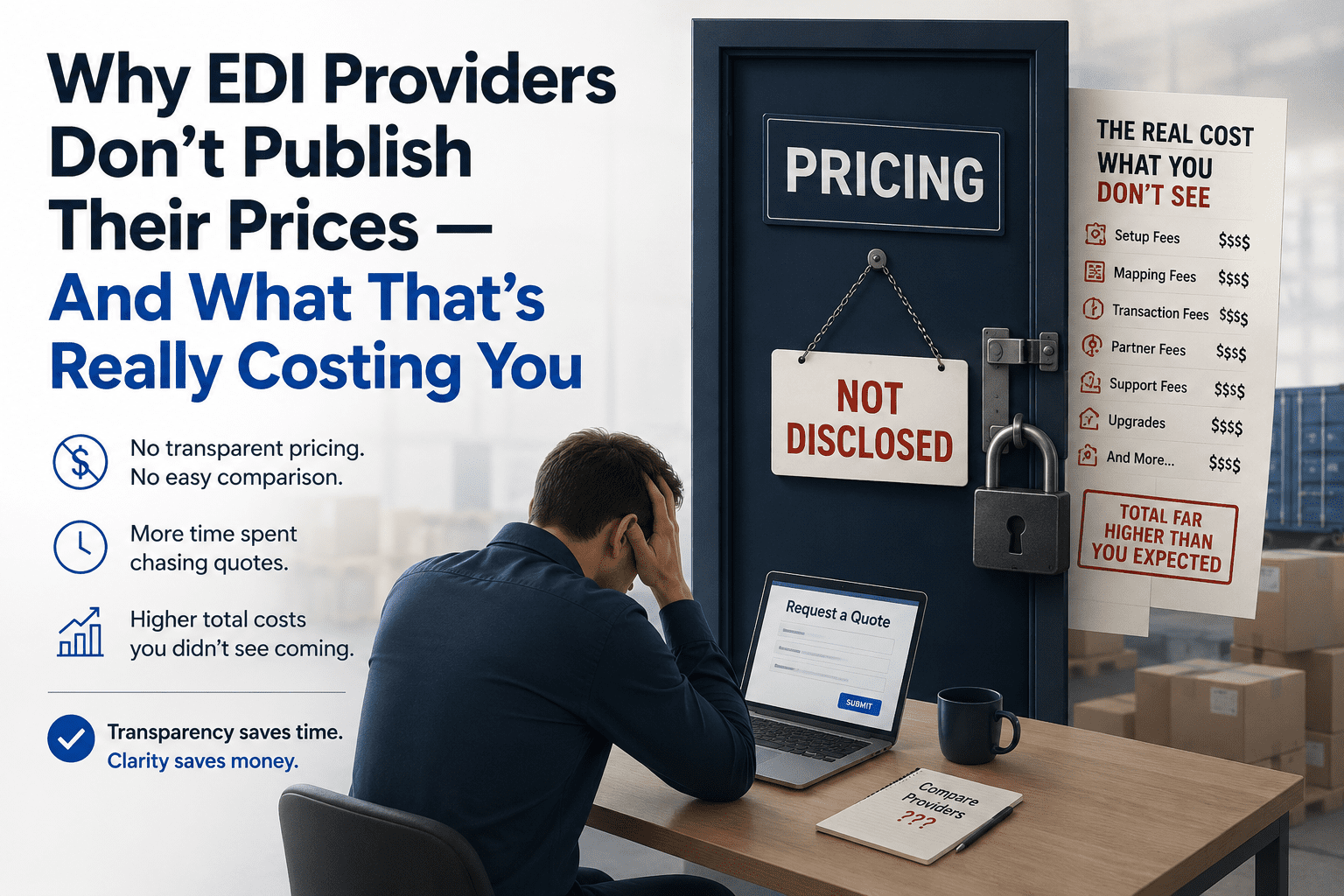

And What That’s Really Costing You
If you’ve ever tried to find out what EDI actually costs before talking to a sales rep, you already know the answer: you can’t. Almost every EDI provider hides their pricing behind a “contact us for a quote” wall. This isn’t an accident. It’s a strategy — and understanding it will make you a much smarter buyer.
The “Contact Us for Pricing” Wall Is Not About Customization
The most common justification you’ll hear from EDI providers for not publishing prices is that “every business is different” and “pricing depends on your specific needs.” This sounds reasonable. It isn’t.
Yes, EDI implementations vary. But the core pricing structure — a monthly fee based on document volume — is almost universal across the industry. The reason providers don’t publish it has nothing to do with complexity and everything to do with psychology.
When you don’t know what something costs, you can’t comparison shop. And when you can’t comparison shop, the provider controls the entire conversation.
The Psychology Behind Hidden Pricing
There is decades of consumer psychology research behind why companies hide prices. Here’s what’s actually happening when an EDI provider asks you to “request a quote”:
Anchoring. The first number you hear becomes your reference point. If a sales rep opens with a $2,000/month quote and then “works with you” to get to $800/month, you feel like you got a deal — even if the fair market price is $200/month. You never knew the real baseline, so you have no way to evaluate whether $800 is reasonable.
Sunk cost of time. By the time you’ve sat through a 45-minute demo, answered qualification questions, and waited three days for a custom quote, you’ve invested time. Psychologically, walking away feels like wasting that investment. Providers know this. The longer the sales process, the harder it is to say no.
Information asymmetry. The sales rep knows exactly what competitors charge. You don’t. That’s an enormous negotiating advantage — and they use it. Hidden pricing is how providers maintain that advantage indefinitely.
Fear of losing the deal. When prices are negotiated individually, reps can charge higher prices to customers who seem less price-sensitive and lower prices to customers who push back. This isn’t personalization — it’s variable pricing designed to extract maximum revenue from each customer.
Manufactured complexity. Hidden pricing allows providers to bundle and unbundle features in ways that make direct comparison impossible. Is trading partner setup included? What about mapping changes? Additional users? Support tiers? When nothing is published, every quote is a different product — and you can never be sure you’re comparing apples to apples.
The Hidden Fees That Never Appear in the Headline Number
Even when EDI providers do share a price, the number they lead with is rarely the number you end up paying. Here are the most common hidden costs in the EDI industry:
Per-trading-partner fees. Many providers charge $50–$200 to onboard each new trading partner. If you have 10 retailers, that’s $500–$2,000 before you’ve processed a single transaction — often not mentioned until you’re deep in the contract.
Per-user fees. Some providers charge monthly fees per user login. A small team of 5 people managing orders can add $100–$500/month to your bill that never appeared in the original quote.
Mapping change fees. Retailer EDI requirements change. When they do, your EDI maps need to be updated. Many providers charge $150–$500 per mapping change — and since retailers update their requirements regularly, this becomes a recurring surprise expense.
VAN transmission fees. Value-Added Network charges for transmitting documents are sometimes passed through to customers separately from the base monthly fee, effectively doubling your per-document cost.
Support tier fees. The monthly fee often includes only email support. Phone support, dedicated account management, or priority response times are add-ons — sometimes significant ones.
Annual contract lock-ins. Providers with opaque pricing frequently require 12 or 24-month contracts. Once you’ve signed, the leverage shifts entirely to them. Price increases at renewal are common precisely because switching costs are high and you’re committed.
Minimum monthly fees regardless of usage. This one is particularly punishing for seasonal businesses or companies just getting started with EDI. Most providers charge a monthly minimum — often $300–$500 — even in months when you have zero transactions. You pay whether you use the service or not.
What Transparent Pricing Actually Looks Like
Transparent EDI pricing means publishing real numbers — not ranges, not “starting from,” not “contact us” — on a public webpage that anyone can read before picking up the phone.
It means:
- A clear monthly minimum with a specific document count included
- A published per-document rate at different volume tiers
- Explicit statements about what is and isn’t included — users, trading partners, support, mapping changes
- A pricing calculator that lets you estimate your actual monthly cost based on your real transaction volume
- A clear policy for zero-transaction months
At Interlink Commerce, our pricing starts at $200/month for your first 250 documents, includes unlimited users and unlimited trading partners, and comes with a No Transaction – No Invoice policy — meaning if you have zero transactions in a given month, you pay nothing. Our pricing calculator is publicly available on our website. You can calculate your exact cost before you ever speak to anyone on our team.
That’s not a special offer. That’s just how we think pricing should work.
Why Most Providers Will Never Publish Their Prices
It’s worth being direct about why the status quo exists and why it’s unlikely to change for most of the industry.
Large EDI providers have sales organizations built around high-touch, consultative selling. Their revenue model depends on maximizing the average contract value — and the best way to maximize contract value is to negotiate each deal individually based on what the market will bear. Published pricing would set a ceiling on every deal.
There’s also a segmentation strategy at work. Enterprise customers with high transaction volumes expect to negotiate. SMBs often don’t know they can push back. Hidden pricing allows providers to charge SMBs enterprise rates while giving enterprises enterprise discounts — extracting maximum revenue from the segment least equipped to negotiate.
Finally, complex pricing structures create switching costs. When your contract includes a mix of base fees, per-document charges, VAN fees, support tiers, and annual commitments, calculating the true cost of switching to a competitor becomes genuinely difficult. That friction benefits the incumbent provider enormously.
What Hidden Pricing Costs You Beyond the Invoice
The financial cost of opaque pricing is measurable. The operational cost is less obvious but equally real.
Time. The average B2B software evaluation involves 3–5 vendor calls, multiple demos, and weeks of back-and-forth before you receive comparable quotes. For a small business owner or operations manager, that’s 10–20 hours of time that could have been spent running the business — all because providers won’t publish what they charge.
Bad decisions made under pressure. When pricing isn’t available upfront, buyers often make decisions based on incomplete information. A provider that seemed affordable during the demo turns out to be expensive once all the add-ons are factored in — but by then you’ve already signed.
Negotiating from weakness. Without published market rates, you don’t know whether the price you’ve been quoted is fair, inflated, or a good deal. You’re negotiating blind against someone with perfect information.
Distrust that poisons the relationship. If a provider is opaque about pricing before you’re a customer, what does that tell you about how they’ll handle billing disputes, price increases, or contract renewals? Pricing transparency is a signal of how a company operates — and a lack of it tells you something important.
How to Protect Yourself When Evaluating EDI Providers
If you’re evaluating EDI providers and none of them will publish pricing, here’s how to level the playing field:
- Ask for all-in pricing in writing before any demo. Request a complete fee schedule including setup fees, monthly minimums, per-document rates, per-trading-partner fees, per-user fees, VAN charges, and support costs. If they won’t provide it, that’s a red flag.
- Ask specifically about zero-transaction months. “What do I pay in a month where I have no transactions?” The answer tells you a great deal about how the provider thinks about your relationship.
- Ask for a 30-day pilot with no annual commitment. Providers confident in their product and pricing will accommodate this. Those relying on lock-in won’t.
- Request a reference from a customer with similar transaction volume. Ask that customer what they actually pay monthly, including all fees. Compare it to your quote.
- Get all pricing in the contract, not just the quote. Verbal quotes and proposal documents aren’t binding. Make sure every fee — including the conditions for price increases at renewal — is in the signed agreement.
The Bottom Line
Hidden EDI pricing isn’t a quirk of the industry. It’s a deliberate strategy designed to maximize revenue at the expense of buyer confidence and informed decision-making. It wastes your time, distorts your decisions, and sets up a supplier relationship that starts with an information imbalance — one that never fully rights itself.
You deserve to know what something costs before you invest time evaluating it. You deserve pricing that doesn’t change based on how hard you negotiate. You deserve to pay nothing in months when you use nothing.
That’s the standard we hold ourselves to at Interlink Commerce. Our pricing is published. Our calculator is live. Our No Transaction – No Invoice policy is unconditional. If you want to know what EDI will cost your business, you don’t need to talk to a sales rep — you can find out right now.
Calculate your exact EDI cost →
Interlink Commerce is a managed EDI and API integration provider for SMBs. SOC 2 certified. $200/month starting price. No transaction, no invoice. Most customers go live in 5 days. Book a free consultation to get started.